

Olivia Salmen on Building a Career in Aesthetics
Olivia Salmen, MSN, APRN, CPSN, has built a respected career in aesthetics without ever leaving the practice where she started. In 11 years she has gone from plastic surgery nurse to sought-after injector, national trainer, and conference speaker.
Salmen is a nurse practitioner and certified plastic surgical nurse at Cool Springs Plastic Surgery in the Nashville area. She was named Best Injector in the Nashville Scene’s Best of Nashville 2021 Writers’ Choice awards. At Medical Spa Show 2026, attendees lined up to take photos with her.
On a recent episode of Medical Spa Insider, AmSpa founder Alex Thiersch and Salmen talked about her path into aesthetics, how new nurses can break in, the reality of operating a practice, and how to earn a spot on the speaking circuit. Here’s what she shared.
How did Olivia Salmen get into aesthetics?
Salmen started on the surgical side of plastic surgery and was invited to start injecting by the surgeon she worked for. When she was in nursing school, she said, aesthetics “wasn’t really a talked-about field for nurses,” so she didn’t know it was an option.
Her first job out of nursing school was in plastic surgery, assisting in the operating room for Dr. John Moore, the surgeon she still works with today. During a facelift, he noticed she was good with her hands. “He eventually just asked me, ‘Would you want to inject?'” she recalled. She believes he saw that she could build and run her own patient base.
Her time in the OR became one of her biggest advantages as an injector. Watching facelifts gave her a working map of facial anatomy. “It’s better than any cadaver course you could go to,” she said. “Cadavers are great, but they’re a little shriveled up. It’s different than seeing live tissue.”
Learning from the best, early
A few months into injecting, Salmen attended an advanced training. She disagrees with trainers who say beginners should stick to beginner courses.
“It humbled me on what I thought I knew,” she said. “And it probably kept me from doing some stupid stuff, because I realized how complex it is, how dangerous certain things can be.”
Why did she earn her NP and CPSN credentials?
Salmen pursued extra credentials to protect her career against regulatory change and to stand out in a crowded field. She began injecting as a registered nurse, which she noted is allowed in Tennessee. Rules on who can inject, and under what supervision, vary by state.
About four years ago she earned her nurse practitioner degree, even though it didn’t change her day-to-day work. “I didn’t want to have to worry about being grandfathered in if Tennessee laws did change, and then it’s an NP-only state,” she said. “There’s a lot of regulation change happening.”
She also earned the Certified Plastic Surgical Nurse (CPSN) credential. Many injectors know the Certified Aesthetic Nurse Specialist (CANS) credential better. Both are awarded by the Plastic Surgical Nursing Certification Board, but they cover different ground:
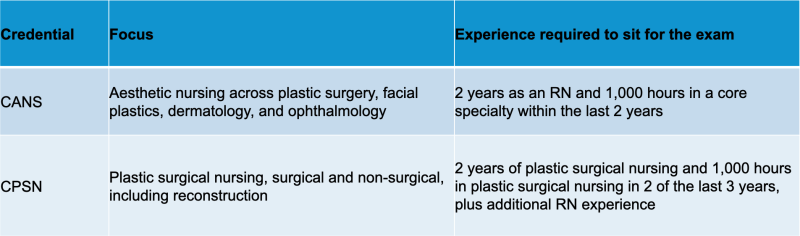
*Requirements summarized from Nurse.org.
The CPSN fit the surgical and non-surgical work she was doing. It also helps her spot when a patient would be better served by surgery. For providers building a career, she said, these credentials signal commitment: “It markets you more to say, I’m putting in the work. I’m not just opening a med spa because I think it sounds fun.”
How can nurses break into aesthetics?
Salmen’s advice is to get a job on the surgical side in any role you can, and earn your way into injecting from inside. “How do I get into aesthetics?” is one of the most common messages she gets on Instagram from nursing students.
Why starting in plastics gave Olivia an advantage:
- A single course won’t set you apart. You can’t just say ‘I took this one three-hour course and I’ve got a little certificate that says I’m now trained in Botox.’ “No one cares about that,” she said. “We know it takes so much more than that to be good.”
- Practices don’t want to train from zero. Aesthetics training can cost thousands of dollars per course. Employers are more likely to invest in someone they already know and trust.
- Established practices offer better training. Offices that already buy from major manufacturers can arrange training with models and expensive products you would struggle to access on your own.
- You’ll find out if you like it. Working in the field first lets you test your interest before investing heavily.
It can take patience. At her practice, some nurses work in the operating room while waiting for an injector role to open. “Maybe you’re in the OR, maybe you’re in clinic, but you’re in,” she said.
What makes a great injector?
In Salmen’s view, a great injector needs an artistic eye as well as medical knowledge. “You could be the smartest person in the world. If you don’t have an artistic eye, you won’t be good at this,” she said. “You can’t just measure a face and make someone beautiful.”
She looks for that eye when she trains providers and helps practices expand. Some injectors have it almost from the start, she said, while others have to work harder to develop it.
For Salmen, the work brings together two passions. Growing up, she planned to become a National Geographic photographer. Aesthetics, she said, lets her combine that creative side with her medical career, and she knew early on that she’d stay in it for the long haul.
Should you open your own med spa or stay in a practice?
There’s no single right answer, Salmen said. Ownership and employment each have real pros and cons, and the right choice depends on your goals and lifestyle. She has considered opening her own practice. Staying has worked for her because it supports the life and career she wants.
Her schedule shows why. She sees patients Monday through Wednesday and flies out most Wednesday nights to train or speak. “When I leave, the lights are on, the patients are taken care of, the phones are taken care of,” she said. “I’m not hiring, firing anybody.” As an owner, she believes she’d travel far less, because “everything still comes back to you.”
If you’re weighing the same decision, she offered this advice:
- If you stay, make sure your contract is worth it. You won’t take home everything you produce when you don’t own the practice.
- Look for mutual respect. She and Dr. Moore value each other’s contributions, including his role as medical director in an area with growing oversight requirements. Without that relationship, she said, leaving may be worth it.
- Know the real cost of ownership. “People just think, ‘I sell this syringe for $900, I get all of that,'” she said. “No, you’re paying a lot of other pieces. Make sure you know what you’re actually making.”
- Be honest about the lifestyle. She knows longtime owners who are now selling to private equity because they’re tired. “Just make sure it’s for you.”
A trusted resource for her colleagues
Today Salmen is one of the experienced injectors at Cool Springs Plastic Surgery whom newer providers turn to. The practice has four locations and, she said, about 14 providers. She helps onboard new injectors and joins the practice’s quarterly after-hours trainings on new techniques. She isn’t a manager, which she said keeps relationships collegial.
How do you become an aesthetics speaker and trainer?
Start small, build a track record of speaking, and only take the stage on topics you truly know. That’s how Salmen built a career as one of the industry’s go-to trainers and speakers.
She knew early that she wanted to teach. Public speaking never scared her, and her first big stage gave her “a little adrenaline rush” she loved. She credits preparation for her confidence.
Her advice for providers who want to speak:
- Build a speaking resume first. Conferences want proof you’re comfortable on stage. “Submitting an abstract is very hopeful with nothing else to back it,” she said.
- Create your own opportunities. Host private trainings, even for 10 people. Early in her career, Salmen volunteered to speak about aesthetics to about 100 nurses at a Tennessee Nurses Association event at her alma mater, Lipscomb University. Many young nurses came up afterward to ask how to get into the field.
- Step up gradually. Move from groups of 10 to 50 to 100 and beyond, so each opportunity supports the next.
- Only speak where you’re an expert. Salmen turns down talks outside her expertise, including a recent invitation to speak on body contouring. “If I don’t think I can be one of the leading voices in the room, I’m not gonna get on stage for it,” she said. Attendees paid to learn from the best person for the topic.
What’s next in aesthetics?
Salmen is most excited about the shift toward natural results and how it pairs with regenerative aesthetics. Patients today are “much more realistic” than they were years ago, she said, and fewer ask for treatments she needs to talk them out of. She called the combination of natural aesthetics and regenerative treatments “a chef’s kiss marriage.”
She is also watching how the FDA approaches peptides and compounding. Her concern is patient safety: many people buy “research” peptides because they’re easy to get, without knowing what’s actually in the vial. She would rather see patients get peptides from compounding pharmacies. “If we can make it easier for them to get safe peptides, it’s going to better the stigma around peptides too,” she said.
Federal and state rules on compounded peptides are changing. Practices should confirm current requirements before offering them.
Key takeaways for med spa professionals
- Get in the door first. A role in a dermatology or plastic surgery office, in any capacity, beats a stack of short-course certificates.
- Train above your level. Advanced courses early on can show you how much you don’t know yet, and keep you safe.
- Invest in credentials. An NP degree or a CPSN or CANS certification can protect your career as regulations change and set you apart.
- Develop your eye. Anatomy knowledge is essential, but artistry separates good injectors from great ones.
- Choose ownership with clear eyes. Know the true costs and lifestyle demands. If you stay in a practice, make sure your contract reflects your value.
- Earn the stage. Build a speaking resume step by step, and only speak where you’re an expert.
Listen to the full episode
Watch Olivia Salmen’s full conversation with Alex Thiersch on YouTube, or find Medical Spa Insider wherever you get your podcasts.
Want a community to support your own career? Become an AmSpa member for compliance resources, business guidance, and connections across the industry.
