Misinformation on Hyaluronic Acid (HA) Fillers Taking Over Your Practice? A New Fact-Based Campaign by Allergan Aesthetics Sets the Story Straight
Medical spa professionals are at the forefront of an evolving aesthetics landscape, where patient perceptions of injectable fillers are increasingly influenced by a complex mix of information coming from a variety of sources. Social media and pop culture conversations have contributed to the rise of misinformation–which has resulted in growing skepticism and concerns about unnatural results, safety, and side effects of injectable fillers.
Despite the social media noise, 46% of healthcare practitioners (HCPs) report an increase in dermal filler demand in the past two years.1 In fact, injectable hyaluronic acid fillers are the most commonly used type of dermal filler today in cosmetic facial procedures.2
To drive greater understanding around hyaluronic acid injectable fillers, Allergan Aesthetics launched the “Naturally You” campaign and released the “Aesthetics Evolution: The Hyaluronic Acid Injectable Fillers Report.” This report is a first-of-its-kind, sharing Allergan Aesthetics proprietary market research, third-party data, and insights from healthcare providers to re-educate and provide fact-based clarity to the aesthetics industry and consumers.
The goal of this campaign is clear: Dispel common myths, elevate understanding and underscore the potential for achieving subtle, natural-looking results with HA injectable fillers.3
The Reality of HA Fillers: Popularity, Satisfaction, and the Perception Gap
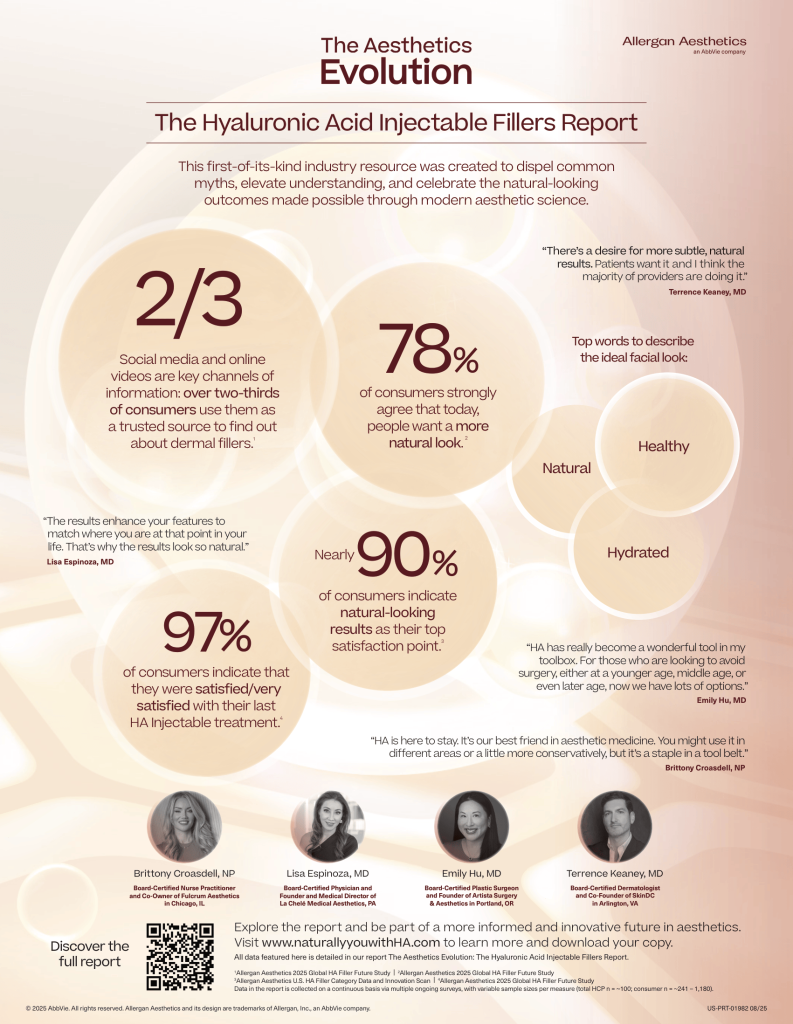
HA injectables are minimally invasive, temporary, and if a rare side effect occurs, dissolvable, with a well-established safety profile.4,5,6,7 It’s no surprise, then, that data from the American Society of Plastic Surgeons shows HA Injectables were ranked number two among minimally invasive aesthetic procedures in 2024.8 Furthermore, research has shown that an impressive 97% of consumers indicated they were satisfied/very satisfied with their last HA injectable treatment.9
Despite HA fillers’ widespread popularity,5 Allergan Aesthetics found that just 1% of the 2.7 million digital discussions about dermal fillers in the US explicitly mention HA injectables by name. This underscores a critical gap in public understanding, which could in turn impact patient awareness and consultation.10
“I think social media and HA filler have grown together, and each has certainly had its growing pains,” said Emily Hu, MD, Board-Certified Plastic Surgeon and Founder of Artista Surgery & Aesthetics in Portland, Oregon. “Social media has opened people’s eyes to possibilities, and they can see before-and-afters much more quickly and easily.”
Social media and online videos are information resources for over two-thirds of consumers researching dermal fillers.1 Most consumers who are considering HA injectables have heard, seen, or read about dermal fillers online11–but most people don’t know how HA differs from non-HA products.12 The report notes that this presents HCPs with an important opportunity to highlight patient concerns, address misconceptions directly, and provide information rooted in hands-on expertise.
Aligning with “Natural” Patient Preferences
Today’s aesthetic consumers’ preferences are continuing to evolve, and aligning with these preferences is key to practice growth.
Notably, a key finding from the report indicates that 91% of Gen Z and younger millennials believe “provides natural-looking results” is an extremely or very important factor when choosing aesthetic treatments.13 This clear preference signals a move away from exaggerated aesthetics toward subtle, refreshing enhancements, with a goal of not looking too “overdone.”14 The report found that in the United States, the top words used to describe the ideal facial look among filler users are positive, emotive terms: natural, healthy, hydrated.12
Fortunately, natural-looking outcomes and proven safety are achievable with HA injectable fillers and precisely what this new generation seeks.5,13 By correcting misinformation and elevating understanding of the category, practitioners can demonstrate how HA fillers align perfectly with this modern aesthetic preference, thereby fostering continued demand.3
Empowering Med Spas: Your Toolkit for Clear Communication
Allergan Aesthetics “Naturally You” campaign represents an industry-wide call to action, focusing on education as empowerment. They are actively partnering with HCPs and influencers to drive accessible and accurate conversations.
By establishing an educational presence and sharing valuable, evidence-based resources from the “Aesthetics Evolution: The Hyaluronic Acid Injectable Fillers Report,” medical spas can enhance patient communication and build trust, especially among those hesitant about fillers due to online myths.
Furthermore, the Naturally You website (www.naturallyyouwithHA.com) serves as a central hub. Here, practitioners can access the full report, along with supplementary educational tools and customizable social media assets, designed to bolster their online communication strategies and patient consultations.
While HA fillers stand as one of the most thoroughly researched and understood aesthetic interventions available today, ensuring patients feel confident and fully informed about their choices is paramount.5 This can only be achieved through open communication, continuous factual education, and dedication to understanding patients’ evolving preferences.
1 Allergan Aesthetics 2025 Global HA Filler Future Study
2 Johns Hopkins Medicine. Dermal Fillers. Accessed January 2, 2026. https://www.hopkinsmedicine.org/health/treatment-tests-and-therapies/dermal-fillers
3 Victor G. Lacombe. Volumizing Fillers for Skin Selection Strategies. Facial Plastic Surgery Clinical North America. Published 2023. https://pubmed.ncbi.nlm.nih.gov/37806685/
4 Rod Rohrich. Practical Approach and Safety of Hyaluronic Acid Fillers. Special Topic Cosmetic. Published 2019. https://pubmed.ncbi.nlm.nih.gov/31624663/
5 De la Guardia C, Virno A, Musumeci M, Bernardin A, Silberberg MB. Rheologic and Physiochemical Characteristics of Hyaluronic Acid Fillers: Overview and Relationship to Product Performance. Facial Plastic Surgery. Published February 3, 2022. Accessed January 2, 2026. https://pubmed.ncbi.nlm.nih.gov/35114708/
6 Frederic S Brandt. Hyaluronic acid gel fillers in the management of facial aging. Clinical Interventions in Aging. Published in 2008. https://pubmed.ncbi.nlm.nih.gov/18488885/
7 Kevin Christopher Smith. Reversible vs. nonreversible fillers in facial aesthetics: Concerns and considerations. Dermatology Online Journal. Published in 2008. https://pubmed.ncbi.nlm.nih.gov/19061563/
8 American Society of Plastic Surgeons. Procedural Statistics Release, 2024. https://www.plasticsurgery.org/news/plastic-surgery-statistics
9 Allergan Aesthetics 2025 Global HA Filler Future Study
10 Allergan Aesthetics JVD Fillers Landscape Social Insights Report 2025, citing data from Infegy. U.S. January 2023 – May 2025. Instagram, TikTok, X, and Reddit.
11 Allergan Aesthetics BCG Global HA Strategy & Analysis
12 Allergan Aesthetics U.S. HA Filler Category Data and Innovation Scan
13 Allergan Aesthetics 2024 Filler Consumer A&U Study
14 Sylwia Lipko-Godlewska. Whole-Face Approach with Hyaluronic Acid Fillers. Clinical, Cosmetic and Investigational Dermatology. Published in 2021. https://pubmed.ncbi.nlm.nih.gov/33633459/