

AI Is Reshaping the Med Spa Industry. Is Your Practice Ready for What That Means?
By Matt Rahman, President & Managing Partner at Safelink Consulting Inc.; and David Carter, Senior Director, Compliance at VIO Franchise Group
Over 80% of physicians now use AI professionally, a rate that’s doubled in three years. In medical aesthetics, AI has arrived in the marketing funnel, the booking workflow, the treatment room, and the documentation system simultaneously. The opportunity is genuine. The governance gap is real. Most med spa practices are not yet asking the questions that determine which side of that line they land on.
The AMA’s 2026 Physician Survey on Augmented Intelligence — 1,692 physicians across all specialties — provides the clearest available picture of AI adoption in medicine. For med spa operators, the marquee finding is not enthusiasm, benefits, or adoption. It is this: clear liability frameworks for AI errors ranked as the #1 regulatory priority, selected by nearly a third of physicians as the single most important action needed. AI tools are being adopted faster than the legal and operational frameworks designed to govern them. The gap between adoption and governance is where the exposure lives.

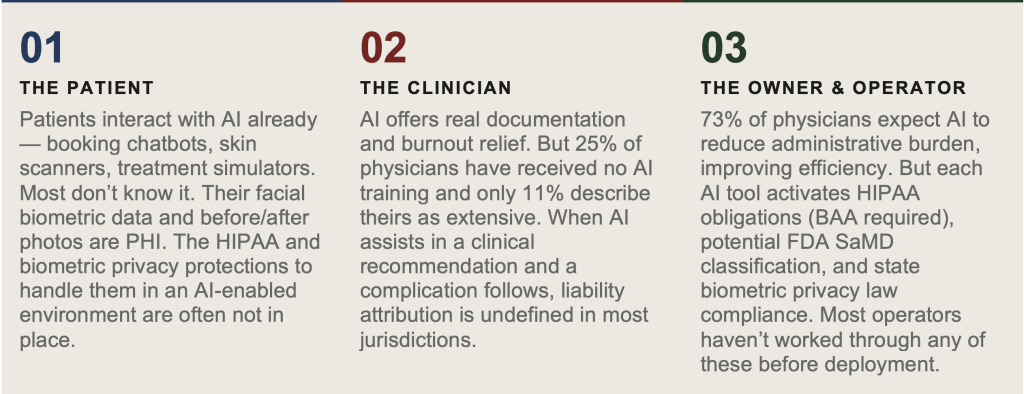
THREE PERSPECTIVES. ONE COMMON GAP.
What AI Means Across the Entire Practice Ecosystem
AI does not look the same from every position in the practice. Patients, clinicians, and owners each face distinct exposures — and each deserves a clear-eyed view of what responsible AI adoption requires of them.
AMA 2026 PHYSICIAN AI SURVEY
Patient privacy is the only dimension in the AMA survey where physicians anticipate net harm from AI, with concerns sharper for non-institutional tools (71%) than for institutionally provided ones (42%). For med spa operators selecting AI vendors independently, the entire privacy and validation burden falls on the practice.
AI in the med spa is not a future compliance question. It is a current one. The practices that get ahead of it are the ones that apply the same discipline to AI governance that they apply to supervision, documentation, and infection control — before the incident that makes it necessary.
— David Carter · VIO Franchise Group & Matt Rahman · SafeLink Consulting Inc.
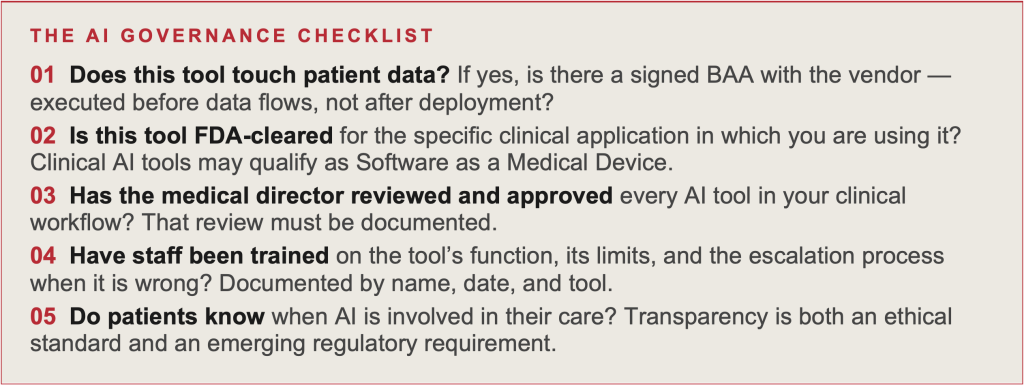
THE MINIMUM STANDARD
Five Questions Every Practice Should Answer Before Any AI Tool Goes Live
SafeLink and V/O work with med spa practices, franchise networks, and multi-site operators to build the compliance infrastructure that makes AI adoption defensible. For the full analysis — including detailed governance frameworks, regulatory deep-dives, and perspective-specific action plans — see our companion white paper: “AI in the Med Spa: A Compliance Intelligence White Paper.”
SOURCES & REFERENCES
1. American Medical Association, Center for Digital Health and AI. 2026 Physician Survey on Augmented Intelligence. March 2026. n=1,692 U.S. physicians.
2. Almukhtar RM et al. Supervision Unveiled: Navigating the Supervision Landscape in Medical Spas. Dermatol Surg. 2024;50(10):954–957.
3. Second national medspa supervision study. Dermatol Surg. 2025. (ASDS) [full citation on file].
4. FDA. AI/ML-Based Software as a Medical Device (SaMD) Action Plan. fda.gov/medical-devices.
5. HHS Office for Civil Rights. HIPAA and Health Information Technology. hhs.gov/hipaa.
