

Med Spa Event Marketing Starts Before You Send the Invite
A packed room does not automatically mean a successful event.
If people come, have a drink, watch a demo and leave without booking, your team may have created a great experience—but not necessarily a great business result.
For medical spa owners, the better question is: What do we want people to do next?
That decision should come before you choose the food, order signage or post the first invitation.
Jessica Wisner of Symplast outlined this approach in her Medical Spa Show 2026 presentation available through MSS Replay. Her central idea is simple: connection builds confidence, and confidence leads to conversion.
That is especially important in medical aesthetics. Patients are making decisions about their appearance, their health and sometimes a significant financial investment. Your event should give them the information, personal connection and clear next step they need to feel comfortable moving forward.
Here is how to build that kind of event.
Start With One Clear Goal
It is easy for a med spa event to become a little bit of everything.
You want to introduce new patients to the practice. Promote a new device. Sell memberships. Fill the injector schedule. Thank existing patients. Maybe launch a skincare line while you are at it.
The problem is that when everything is important, guests may not know what you actually want them to do.
Before you plan the event, answer one question:
What would have to happen for us to consider this event a success?
Maybe you need:
- New patient bookings;
- Consultations for a high-ticket treatment;
- Membership enrollments;
- Deposits on a new service; or
- Referrals from existing patients.
Choose the primary outcome first.
Then build the event around one hero service or offer.
An injectables night can focus on getting appropriate patients into the schedule. A device event may need more education and one-on-one consultation before someone is ready to commit. A membership event should help patients understand why joining makes sense for the way they already use your practice.
The more focused the event, the easier it becomes for everyone.
Your marketing team knows what to promote. Your providers know what to talk about. Your front desk knows what to book. And your guests leave knowing exactly what their next step is.
Broad open houses can still work, particularly for VIP patients and community building. But if your goal is patient acquisition, a more focused event usually gives people an easier decision to make.
One event. One primary goal. One clear next step.
Match the Event to What You Want Patients to Do
Different goals call for different events.
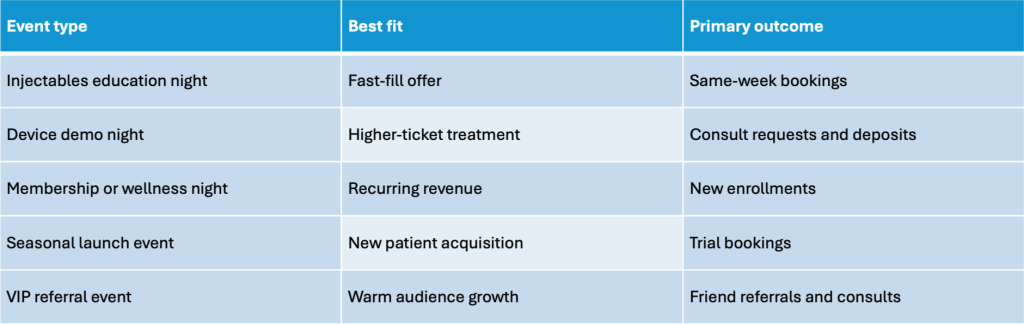
If you want to fill an injectables schedule, patients may be able to make a relatively quick decision.
If you are introducing a larger treatment plan or expensive device procedure, they may need to see the treatment, ask questions and have a short consultation before they are comfortable putting money down.
Do not force every service into the same event format. Start with the decision you are asking the patient to make, then give them what they need to make it confidently.
Build an Offer That Feels Valuable Without Giving Away Your Margin
Discounting is easy. Building a good offer takes more thought.
A deep discount may get attention, but it can also attract patients who are primarily shopping for price—and teach existing patients to wait until your next promotion.
Instead, ask: What would make this offer feel genuinely worthwhile to the right patient?
That might mean combining complementary services into a package, adding an attendee-only perk, offering special event pricing or creating additional value for patients who join your membership.
You can also use a minimum spend or deposit to make sure the offer still makes financial sense for the practice.
The goal is not simply to make the price lower. It is to make the decision easier.
Real urgency can help.
An offer available only to attendees gives patients a reason to make a decision while they are there. For patients who genuinely need more time, a smaller secondary offer lasting another 48 to 72 hours can provide a reasonable bridge without making the event-day offer meaningless.
And remember that a deposit changes the relationship.
Someone who says, “That sounds interesting,” is still thinking.
Someone who puts money down has taken the first step.
Give Yourself Enough Time to Fill the Room
One of the easiest event mistakes is waiting too long to start promoting it.
An Instagram post and an email a few days before the event should not be the entire attendance plan.
Give people time to notice the event, understand why it is relevant to them and decide to come.
A practical runway might look like this:
About four weeks out: Introduce the event, the service and who it is for.
Two to three weeks out: Start answering the questions that could keep someone from registering. Use provider videos, patient stories, FAQs and examples from previous events.
Final week: Increase reminders and make the details easy to find.
Final days: Confirm attendance and personally follow up with people who have not responded.
That last step matters because an RSVP is not the same thing as a person walking through your door.
People forget. Work runs late. Childcare changes. Dinner suddenly sounds easier than driving across town.
Automated reminders help, but sometimes a personal call or text from someone at the practice is what turns an RSVP into an actual attendee.
For the right event, that human touch is worth the effort.
Start With the People Most Likely to Say Yes
Your existing patient list is usually the logical first place to promote an event.
They already know the practice. They know your providers. There is less trust to build.
Use email and SMS to make the invitation clear and easy to act on.
Then look outward.
Organic social can create visibility and give patients something easy to share with friends. Geo-targeted paid social can introduce the event to new prospects in your local market, particularly when you have a clearly defined service and audience.
Referral messaging can help too.
“Bring a friend” is more than a promotional tactic. For someone who has never visited your practice, walking into an event with a friend can make the experience feel much more comfortable.
Local creators, patients and community partners may also help spread the word. But relevance matters more than follower count. Someone your ideal patient already trusts can be more useful than a polished influencer with no real connection to your community.
Make It Easy to Say Yes
Do not make prospective guests hunt for basic information.
Within a few seconds, your invitation or landing page should answer:
- What is happening?
- Who is it for?
- When and where is it?
- What will I get from attending?
- What should I do next?
Then give them a clear RSVP button.
Most people do not need a long explanation before registering for a local event. They need enough information to decide, “Yes, this is for me.”
If mini consultations are part of the event, consider letting guests reserve those times when they RSVP.
That does two useful things. It gives your team a clearer picture of demand before the event, and it gives the patient a more specific reason to show up.
They are no longer simply “going to an event.”
They have an appointment.
Plan the Event Around the Patient’s Next Step
A busy room feels good.
But your event should not depend on energy alone to create bookings.
Think through the guest experience from beginning to end:
Welcome → Education or demo → Questions → Mini consult → Offer → Booking
Every step should naturally lead to the next one.
A common mistake is putting a lot of effort into the presentation and almost none into what happens afterward.
Your provider gives a great demonstration. Patients are engaged. Everyone applauds.
Then someone says, “Call us if you want to schedule.”
You have just added another decision, another task and another opportunity for that patient to forget.
Make booking part of the event.
While interest is fresh, show people exactly what comes next and give them a simple way to take that step.
Give Every Team Member a Clear Role
The event will run more smoothly when your staff knows exactly what they are responsible for.
For example:
- Someone welcomes guests and checks them in.
- A provider teaches or demonstrates.
- Another team member manages short consultations.
- Someone else handles scheduling, deposits and payment.
This does not mean every interaction should feel scripted.
It means patients should never reach the end of the experience and wonder, “Who am I supposed to talk to now?”
Clear roles also make the event easier on your staff. Instead of everyone trying to do everything, each person knows where they fit.
Use Mini Consultations to Help Patients Make the Decision
For many treatments, education alone is not enough.
Patients need to understand what the treatment would mean for them.
A short, focused consultation can bridge that gap.
Keep it manageable—around 10 to 15 minutes—and give it a purpose.
Discuss the patient’s goals. Determine whether the treatment is appropriate. Answer the most important questions. Then explain the recommended next step.
If appropriate, provide a written estimate or package.
That makes the decision concrete.
Pre-booking these consultations during registration can also help you pace the event and identify your highest-intent attendees before they arrive.
Make Booking and Deposits Part of the Plan
If someone is ready to move forward, make it easy for them to do so before they leave.
- Have appointment availability ready.
- Have payment links or your checkout process ready.
- Make sure the staff member handling bookings understands the offer.
- If a deposit is appropriate, explain it clearly.
That deposit can protect provider time, reduce no-shows and give the practice a better idea of the revenue generated by the event.
Urgency can help patients make a decision, but it should still feel reasonable.
Set a clear deadline for event pricing or bonuses. Explain the terms. Give patients the information they need.
You do not need to manufacture pressure. You need to remove ambiguity.
Build the Follow-Up Before the Event Happens
Some of the most valuable event work happens after everyone goes home.
That means the follow-up plan should not be something your team figures out the next morning.
Decide in advance:
- Who will follow up?
- Which patients will receive a call?
- Who gets a text?
- Who gets an email?
- How quickly?
- What happens if someone attended but did not book?
- What happens if someone registered but never showed up?
Wisner recommends continuing follow-up for seven to 30 days because event revenue does not always happen on the night itself.
Patients may need to check a calendar, talk to a spouse, think about financing or simply have another conversation with the provider.
Do not mistake “not tonight” for “not interested.”
Give your team a system for continuing the conversation.
Follow Up Based on What the Patient Actually Did
Everyone should not receive the same post-event email.
Someone who attended and purchased is in a very different place from someone who registered and never came.
At minimum, separate your follow-up into a few groups.
Attended and purchased: Thank them, reinforce the decision and make sure the appointment process is clear.
Attended but did not purchase: Follow up personally. Answer questions, offer a consultation if appropriate and remind them of any legitimate short-term offer.
Registered but did not attend: Reach out quickly while the event is still fresh. Give them another way to learn about the treatment or schedule a consultation.
Cancelled: Acknowledge the cancellation and make it easy to reconnect.
This is not complicated personalization.
It is simply responding to what the patient actually did.
Turn a Successful Event Into Something You Can Repeat
The best event should make the next event easier.
Save what worked:
- Landing pages;
- Email and SMS sequences;
- Provider videos;
- Presentations;
- Intake forms;
- Consultation scripts;
- Offer structures;
- Payment links;
- Staff assignments; and
- Follow-up workflows.
Then look at the results.
- How many people registered?
- How many actually attended?
- How many requested consultations?
- How many put down deposits?
- How many booked?
- How much revenue came in that night—and during the following 30 days?
Those numbers tell you more than how crowded the room looked.
Over time, you can build an event process your team knows how to run instead of starting from scratch every time you want to promote a service.
That makes events easier to plan, easier to measure and less stressful for your staff.
Know What You Want to Happen Before You Invite Anyone
A successful promotional event does not start with decorations or an invitation. It starts with a decision.
Know who you want in the room. Know what you want them to learn. Know what you want them to do next. Then build the offer, promotion, event experience and follow-up around that path.
The basic framework is straightforward:
One focus. One relevant offer. A real attendance plan. A clear booking process. Follow-up that does not stop when the event ends.
Most importantly, judge the event by the business it creates—not simply the number of people who showed up.
If you want to go deeper into the strategy behind this approach, Jessica Wisner’s presentation from Symplast is available as part of MSS Replay.
