

Inside AIA Phoenix: What Injectors Learned at AmSpa’s Cadaver Anatomy Lab
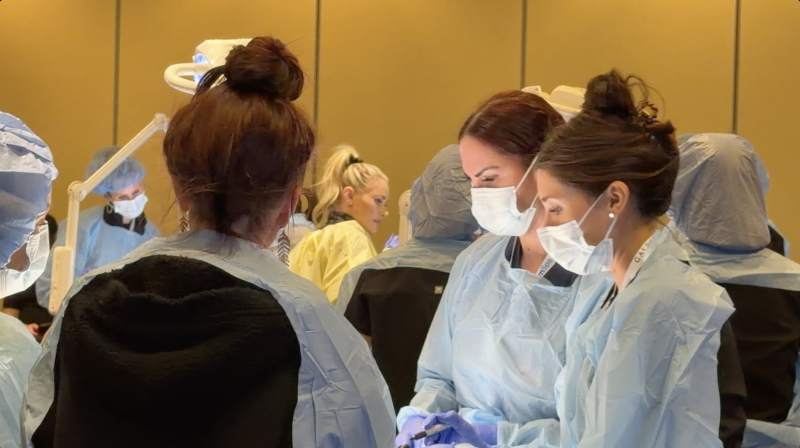
The day before AmSpa’s Academy for Injection Anatomy (AIA) Advanced Cadaver Lab in Phoenix, an FAA disruption grounded flights. Attendees sat in airports for hours, and some landed after midnight. They came anyway.
On the morning of Nov. 14, they were all at the Hilton Phoenix Tapatio Cliffs Resort, ready to start.
“Ultimately our journey from Minneapolis to Phoenix was not as expected or as planned, but nothing in this industry ever is, so I’m really glad that we were able to make it because it was a thousand percent worth it,” said Hailey Vandell, RN, an injector from Minnesota.
What is the AIA Advanced Cadaver Lab?
AIA is AmSpa’s hands-on injection anatomy training for licensed aesthetic injectors, now in its 78th installment. What sets it apart is the sequence: attendees inject product into a specimen, then dissect it to see exactly where it went. Phoenix was a full day:
- Morning: didactic sessions on facial anatomy and facial assessment for the injector, region by region, from the midface and tear trough to the temple, forehead and jawline
- Afternoon: small-group cross-sectional cadaver dissection, with attendees injecting different layers of the face and then dissecting to see where the product went
- Evening: a cocktail reception and book signing with Christopher C. Surek, DO, FACS, board-certified plastic surgeon, renowned facial anatomist and course chairman
The room was a mix of registered nurses, nurse practitioners, physician assistants and physicians, some a couple of years into injecting and some with many years behind them. Several came as practice teams: Michael Lum, DO, brought colleagues, including a PA he mentors, and Une Hardee, PA, attended with a coworker.
What attendees took home
The theme that came up most was how much anatomy varies from one face to the next, and what that means in the treatment chair.
Hailey Vandell, RN, on the moment it clicked: “The moment that something clicked for me today was when I looked at my cadaver and then I looked over at my neighbor’s cadaver and saw that the facial arteries were in two completely different spots.”
Cory Blue, NP, an injector of six years from Kansas City, on what she’s rethinking: “certain injection techniques that I thought were safe aren’t as safe as I thought.” And on why it had to be hands-on: “I mean you can watch a video all day, but until you have it in front of you, hands on, completely different world.”
Une Hardee, PA, of SkinSpirit in the Kansas City area, on what surprised her most: “what surprised me most about this course is seeing how the anatomy differs from one person to the next.” She added: “it’s not a cookie cutter for everyone in my chair.”
Michael Lum, DO, of Torrance, California, on what sets the course apart: “Actually had an opportunity to inject different layers of the face and then dissect out to see exactly where those layers went. I think that’s something that you don’t always have the chance to do in other courses.”
Rebecca Wilson, RN, BSN, a nurse of 16 years from Arizona, on what finally clicked: “A lot of the vascular anatomy clicked for me and it hadn’t before, so I’m really gonna take that home with me.” On the teaching: “He wasn’t speaking above us, which was really helpful.”
Jess Stern, BSN, RN, of Minneapolis, on what she’s taking forward: “I definitely feel like a way more safe injector now. I feel like I will be able to deliver way better results for my patients.”
What changes on Monday
For most attendees, the lab didn’t end when they left the room.
“Monday there’ll be some techniques I’m changing after what I’ve seen here,” said Hardee.
Vandell agreed: “Honestly everything we learned today we’re gonna be taking back home for us.”
Dr. Lum, who has taken several cadaver courses, described the bigger shift: “if you understand the three-dimensional anatomy, it’s gonna change the way you look at things, right?”
Safety first, in their words
AmSpa’s work centers on legal compliance, clinical training and community. AIA is where those meet in the treatment chair, and attendees talked about it in terms of the patient in front of them.
“Your patients will be more comfortable in your chair because your safety is your number one priority and you’re going to exude that confidence when they’re in your chair and you’ll be able to explain the different techniques you use and why you choose them,” said Hardee.
Dr. Lum, who has taken several cadaver courses, put it plainly: “the Academy for Injection Anatomy should be mandatory for anyone who’s interested in injecting safely.”
Wilson’s number one takeaway was shorter still: “knowledge is power and safety is key if you’re an injector.”
A room full of people who do what you do
Table groups of four shared a specimen, and attendees said that shared work was part of the value.
“It was actually very encouraging just to know that there are, you know, so many other practitioners out there, not just from like the state you’re living in, but all over the country. And we are ultimately all on the same team,” said Stern.
“I think it was really refreshing. We were all at the same level. There were physicians there, nurses there, nurse practitioners, physician assistants, but we were all learning the same thing and collaborating together,” said Wilson.
Blue described the same exchange at her table: “They shared their pearls, we kind of shared ours and then seeing it all come together was great.”
Many came because a colleague had told them to. “We chose this one because of word of mouth, honestly,” said Vandell.
What’s next for AIA
The next Academy for Injection Anatomy will be held at the Medical Spa Show 2027, April 15-18, at Wynn Las Vegas. AmSpa members save $200 per registration, and team seats are available for practices that want to train together.
For anyone on the fence, Stern had one piece of advice: “Do it a hundred percent and your future self will thank you.”
